Listen

Five pieces,
playing in your browser.

No plugin, no app, no upload, no account. Each one is a real saimox delivery with every object still separate — the render happens on your machine as you listen.

Put headphones on. The switch on the right of each player is not decoration: binaural filtering is built for headphones, and over loudspeakers the crosstalk between them destroys the ear signals and it sounds dull and centred. On speakers, leave it on 🔈.

Every piece opens in the full player too. The link under each one shows the whole object list, both scene views and the streaming controls — the same player, with everything on screen.

The object count in each player is real. It is read out of the file you are streaming, not typed in by us. Five to a hundred and twenty-eight, in the same format and the same player.

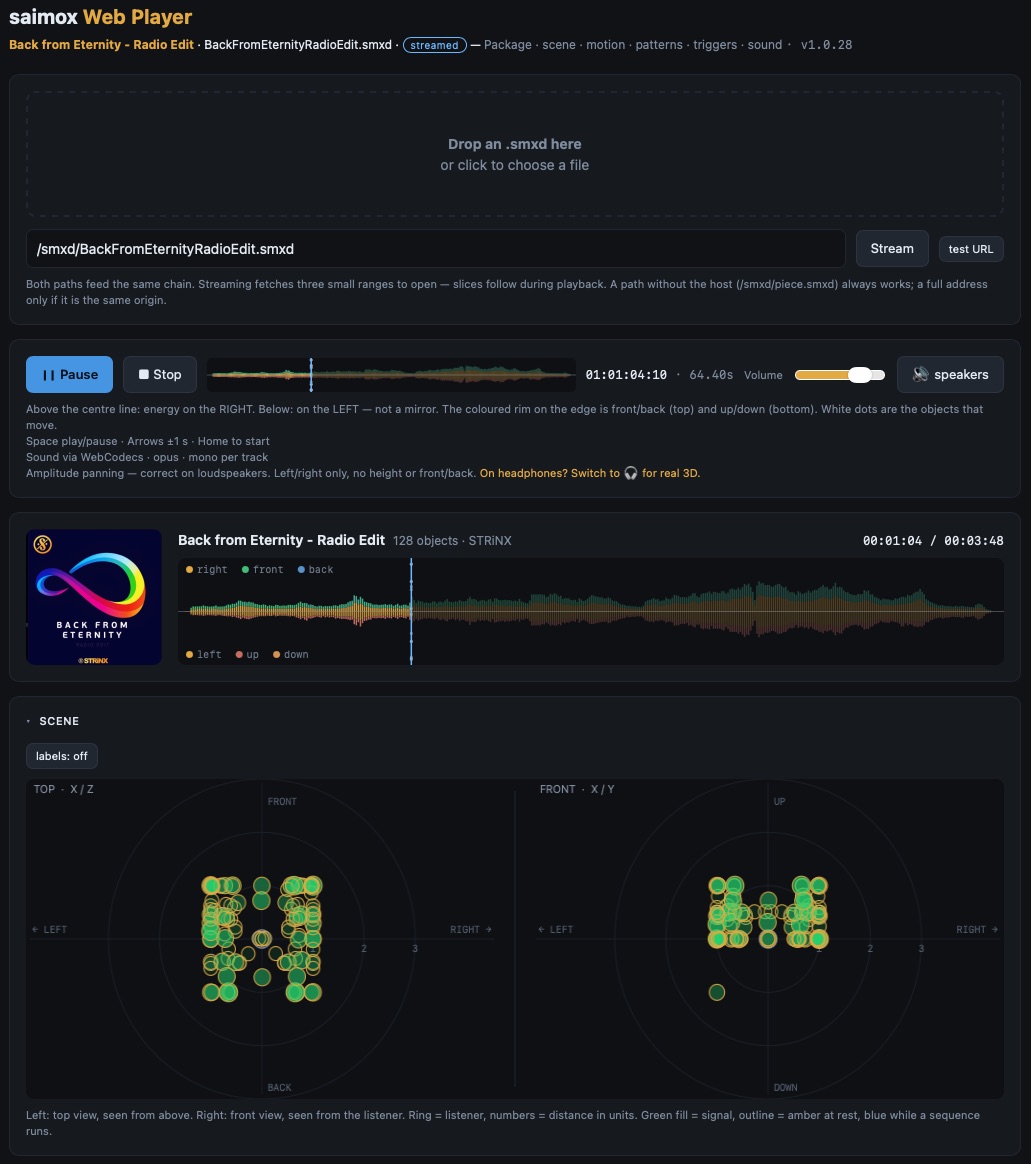
The bar is not a waveform. Time runs across it. Above the centre line is energy on the right, below it on the left — not a mirror image, two different signals. The coloured rim along the top edge is front and back, along the bottom edge up and down. White dots are objects that are moving.

A waveform tells you how loud a piece gets. This tells you where it is, and what changed while you were not looking.
Back from Eternity · Radio Edit
STRiNX · electronic

A three-minute radio edit carrying 128 separate objects, streamed to you over a normal connection. Every one of them is still individually addressable in the file your browser is reading — nothing was merged to make it fit. Open in the full player with object list ↗

Stars 2
electronic

Seven minutes, sixty-six objects, and enough room between them that you can follow single sources by ear. Watch the white dots in the bar while it plays — each one is an object that is moving, not a stereo image being widened. Open in the full player with object list ↗

Arpertium Ecosondium
ambient

Slow enough to hear what distance actually does when it is calculated from a room in metres rather than dialled in with a knob. Close your eyes for this one. Open in the full player with object list ↗

Riding the Wave
STRiNX · electronic

Twenty-two objects, most of them in motion. A demonstration that object count is not the point — what they do matters more than how many there are. Open in the full player with object list ↗

Da Dancin' Duck
STRiNX · club

Five objects. That is the whole piece — and it still works in three dimensions, because five sources placed deliberately beat a hundred scattered by accident. Built for a big system: try it on speakers with binaural off, then on headphones with it on. Open in the full player with object list ↗

What just happened

That was not a stereo file.

The full web player with scene views
The full player. The embedded version above is the compact one. The full player adds the scene from above and from the listener's position, plus the streaming controls — 128 objects here, opened over the network.

And one more

That was not a downfolded file either.

This is the part that is easy to miss, because every other immersive format also ends up as two channels in your headphones. The difference is when.

Nothing about this needed a decision from you, and nothing about it was decided for you in advance. Where the fold happens →

How the format works →  ·  Every player →  ·  Make your own →

Put one on your own page

One script, one tag.

The player is a web component. Drop it into any page — your own site, a label page, a press release — and it carries the piece with it.

AttributeWhat it does
srcPath to the delivery. The only one you need
titleOverrides the title carried in the file
viewMotion map or none
themeDark or light, to match your page
accentAny colour, for the play button and the bar

Any number of players per page. Starting one stops the others. Ask us about embedding →